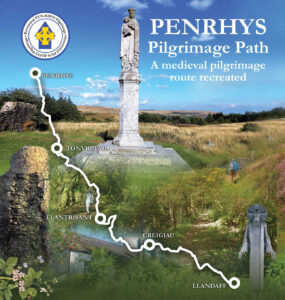
The Penrhys Pilgrimage Way started at Llandaff Cathedral. It went via Danescourt, following the Taff towards Radyr before turning north-west through Pentyrch, Creigiau, Groesfaen where it turned again more northerly to head for Llantrisant, Tonyrefail and Trebanog, then going over the mountain to reach Dinas Rhondda and Trealaw before making the final climb up to the Statue of Our Lady of Penrhys in the Rhondda.
It was an important medieval Marian pilgrimage, namely to a Shrine of the Virgin Mary. In 1538 Thomas Cromwell ordered that the Statue should be taken to London. There, it was one of three Statues of Our Lady recorded as publicly burnt.

At the time of the Pilgrimage there were around 500 people living in the Parish of Tonyrefail, mainly in the farmhouses that dominated the landscape. Today, the population exceeds 12,000. The earliest church in the area was St John’s (now a Scout Hall) on Llantrisant Road, built in the early 1500s but on a site dating back to the 11th century. In 1326, a significant event occurred nearby when King Edward II was captured at a place now called Pant-y-Brâd (“the hollow of treason”), held overnight in Llantrisant Castle and later murdered.


The village started to emerge at the end of the 18th century with the introduction of a woollen factory and a corn mill. In 1860, a broad-gauge railway line from Llantrisant opened, followed by numerous coal mines. This saw the population increase rapidly, and by 1919, around 1,700 miners were employed in Coedely Colliery alone.

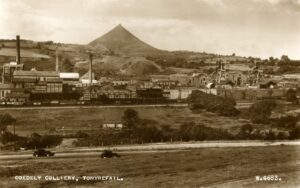
The post-war years saw significant investment in both council and private housing, with most of the areas around Tonyrefail named after original farmhouses such as Collenna, Tylcha and Tyn-y-Bryn.

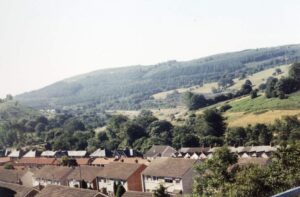
Images reproduced with permission from Rhondda-Cynon-Taff Libraries.
This project was made possible by the National Lottery Heritage Fund, Cadw and the Welsh Government.